
This page displays all of the input submitted by participants through Community Choices, the second round of public input held between November 12 and December 19, 2025. It includes responses from the online survey, webinar, and in-person input provided on paper forms. It is organized into five parts.
Guiding Principles
Total entries: 536
Principles describe the intent about “how” (generally) and “where” (conceptual location) growth and development in Worthington should occur in the future. They are based upon community input and reflect a variety of themes that are mutually reinforcing, including the type, quality, appearance, pattern, character, and organization of development; environmental quality; efficient use of infrastructure; and expanding connectivity and mobility choices.
Participants rated their support for each principle out of 5, where 1 represents low support and 5 represents strong support, and provided comments.
As Worthington develops, it is our intent that:
1. The City’s unique character is strengthened. We will respect and build upon the cherished character of historic places and create a strong sense of place in other areas. The specific character, expressed through building design and materials, public spaces, landscaping, signage, lighting, historic preservation, and public art, will vary between different areas, but it will be intentional, context-appropriate, and contribute to community pride.
Average rating: 4.27
2. Growth focuses on vacant land and underperforming commercial, office, and industrial areas. We will pursue intentional redevelopment for priority aging retail/office areas, legacy industrial districts, and corridor reinvestment sites. We will encourage other corridor areas to evolve in character through incremental, opportunity-driven redevelopment and phased infrastructure and public-realm upgrades.
Average rating: 4.12
3. Walkable mixed-use places—unique and purposeful—are created. We will shape new places that combine shops, restaurants, services, employment space, diverse housing, and a high-quality, pedestrian-scale public realm, converting large blocks and surface parking lots into connected streets and walkable blocks in targeted nodes and corridors.
Average rating: 4.2
4. A broader range of housing serves the community. We will broaden housing types and price points, preserve and reinvest in naturally occurring affordable housing (NOAH), and encourage accessible, age-friendly homes; so young people, families, and long-time residents can reside here through every life stage. New housing will be focused in reinvestment areas, corridors, and mixed-use nodes.
Average rating: 3.8
5. The character of established neighborhoods is honored while accommodating growth. We will help established neighborhoods maintain their character while corridors evolve, supporting context-appropriate infill and additions, requiring transitions in scale at neighborhood edges, encouraging preservation and reinvestment in existing homes, and limiting traffic on neighborhood streets.
Average rating: 4.12
6. Major destinations are connected by safe walking, biking, and transit. We will close sidewalk and trail gaps, improve crossings, calm traffic, expand bikeways, enhance streetscapes, and integrate COTA (and potential BRT) with land use—linking Old Worthington’s Central Business District with schools, parks, employment areas, and new development along High Street, SR-161, and the regional trail network.
Average rating: 4.32
7. The City’s parks and public spaces are elevated. We will enhance the quality, accessibility, and programming of existing parks and civic spaces and, where appropriate, deliver new public spaces as part of larger redevelopment, so these places reflect community values for nature, culture, education, and civic life.
Average rating: 4.31
8. Development and the public realm demonstrate environmental stewardship and resilience. We will protect natural systems (riparian areas, woodlands, steep slopes), expand the tree canopy, apply low-impact development and on-site stormwater management, promote energy-efficient buildings and site design, and encourage native plants, recycling, and composting—as baseline expectations for all significant projects.
Average rating: 4.37
9. Business corridors are modernized to support a resilient economy and workforce. We will expect new mixed-use office development or complementary uses that strengthen existing offices areas in the High Street and Wilson Bridge Road corridors. In the Northeast Area, we will pursue clean and flexible light-industrial and innovation space, provide small-business and incubator opportunities, and create smaller mixed-use nodes to serve these employment uses.
Average rating: 4.11
10. Redevelopment balances the mix of uses to enhance fiscal responsibility. We will use land and infrastructure efficiently, right-size utilities, evaluate life-cycle costs, and align land use with service costs, creating a citywide mix of uses that strengthens Worthington’s long-term finances and capacity to deliver outstanding services.
Average rating: 4.04
Community Preferences
Total entries: 354
Participants answered the following three questions to let us know what considerations are most important to them in the future development of Worthington.
1. To provide more options for living in Worthington “through all life stages” how important is it that Worthington encourage the following housing types beyond single family homes)? (rating 1-5, where 1 represents not important, 3 is neutral, and 5 represents very important)
Accessory dwelling units (carriage houses)
Average rating: 3.39
New age-friendly housing (smaller single-story units like patio homes)
Average rating: 3.91
Attached housing (duplexes, fourplexes, townhomes)
Average rating: 3.22
Multi-family buildings
Average rating: 2.85
All types
Average rating: 3.36
Something else:
Count: 49
2. How important are the following design elements for new mixed-use or multi-family development in Worthington? (rate 1-5, where 1 represents not important, 3 is neutral, and 5 represents very important)
Located near corridors with transit or bike access
Average rating: 3.77
Quality of building materials
Average rating: 4.41
Landscaping with mature trees
Average rating: 4.17
Building scale and site design is appropriate for its context
Average rating: 4.38
Architecture that reflects historic styles
Average rating: 3.86
Building design that avoids fake features (inoperable entrances, facades)
Average rating: 4.09
Centralized and shared parking
Average rating: 3.6
3. Assuming that the city’s future revenue streams are supportive, which of these types of “quality of life” improvements are most important to you (rank 1-4, where 1 is the most important and 4 is the least important):
Something else:
Count: 54
Areas with Opportunity
Total entries: 283
Participants reviewed the statements of intent and example imagery for each of the four Areas with Opportunity, rating how strongly they support this direction, where 1 represents low support and 5 represents strong support, and answered the following questions to explain their rating.
*Image of a place in Worthington
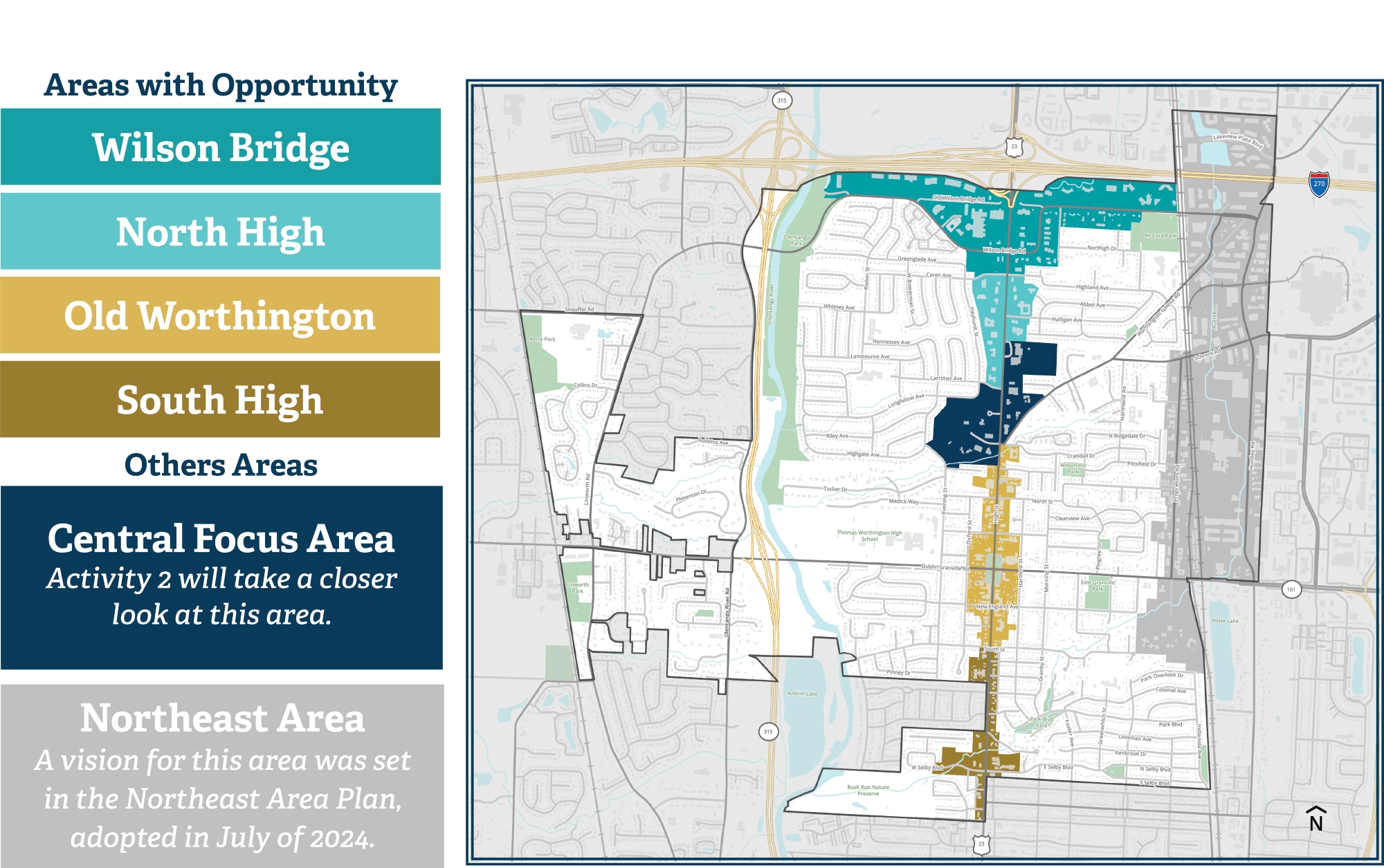

1. Create a vibrant gateway into Worthington to foster community identity.
2. Support redevelopment of underutilized office buildings and parking areas with a mix of uses (office, residential, hotel, etc) in a walkable design, reducing surface parking.
3. Allow greater building heights, high-quality building materials, and architectural styles that are distinct to this area of Worthington. Reduce building scale as a transition to nearby residential areas.
4. Create better pedestrian and bike connections with trails throughout the area and safer paths across High Street.
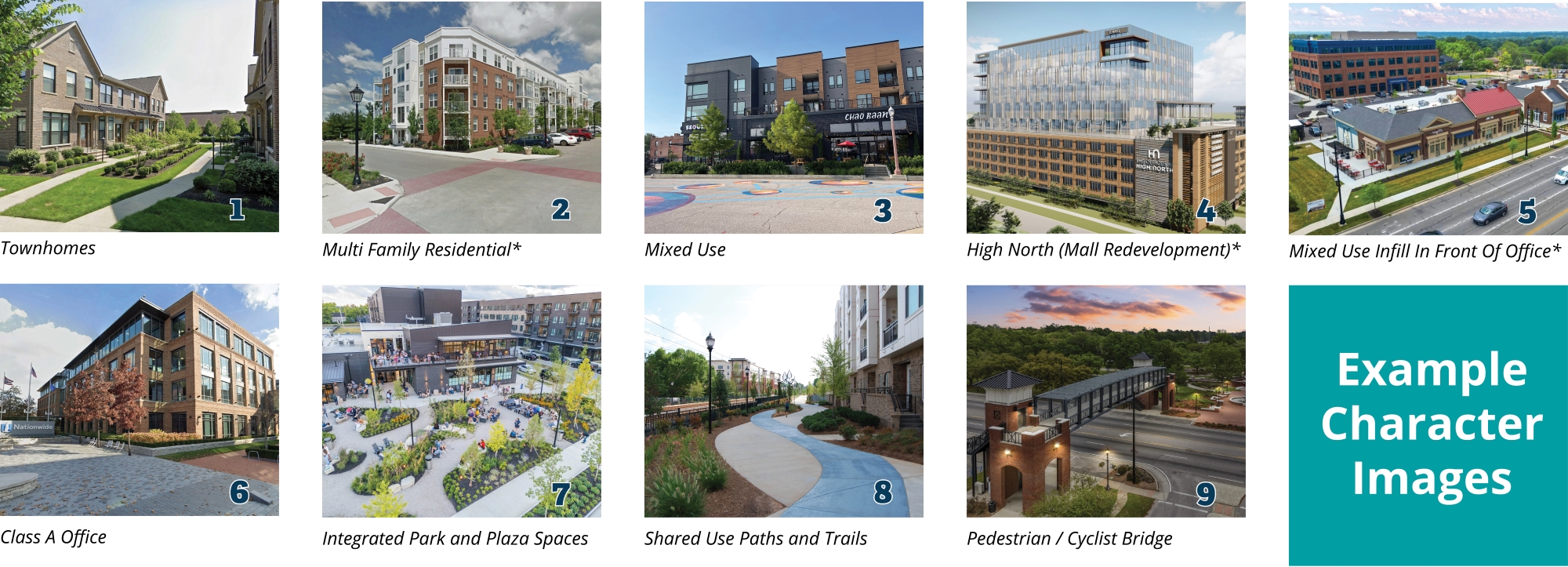
Average Rating: 4.27

1. Support gradual redevelopment to bring buildings closer to the street, with parking behind, creating a more walkable, inviting, and well-connected streetscape.
2. Create a stronger pedestrian and bike connection to Old Worthington with improved landscaping and other streetscape elements.
3. Strategically consolidate properties, parking lots, and access points to High Street between properties to create space that is more attractive for future redevelopment.
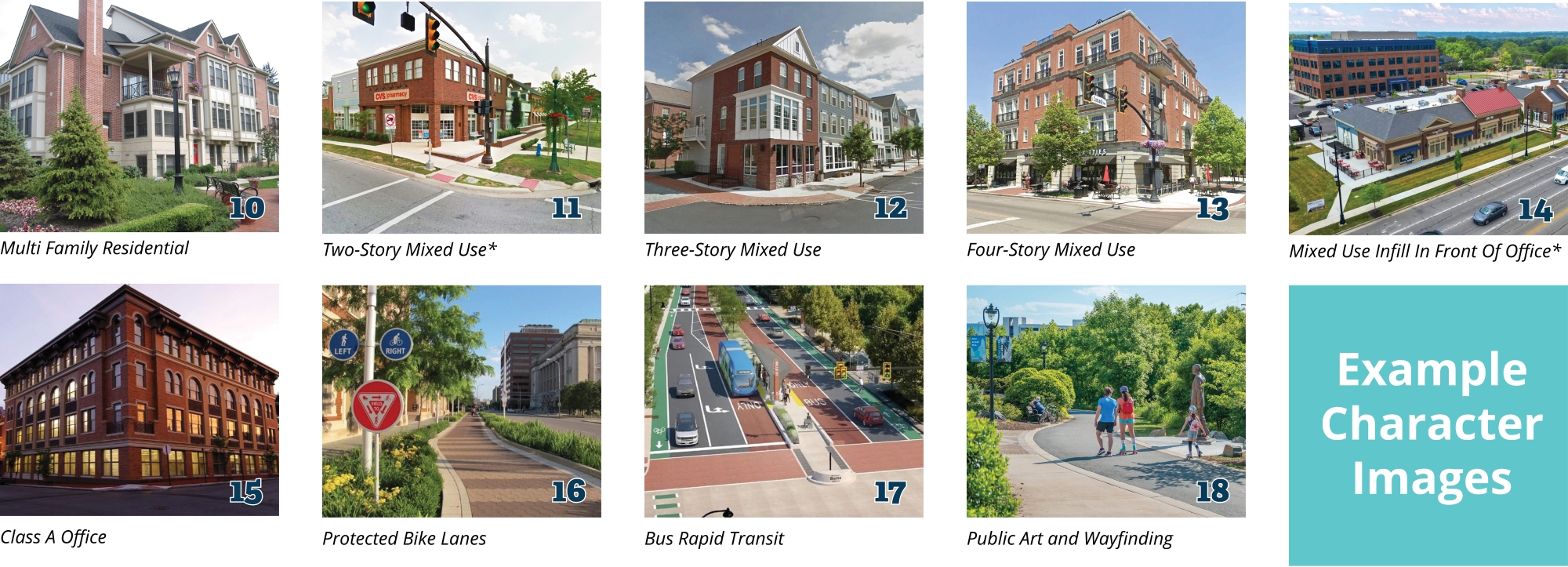
Average rating: 4.18

1. Support development that respects and celebrates the historic character of Old Worthington.
2. Pursue sensitive infill and redevelopment with housing and commercial options that are appropriate with Old Worthington’s historic character, such as accessory dwelling units (ADUs), attached single-family homes, three-four-family homes, and boutique hotels.
3. Create a stronger pedestrian and bike connection to the surrounding neighborhoods with improved landscaping and other streetscape elements.
4. Improve the public realm to encourage social interaction through enhanced streetscape features such as street furniture, public art, and covered bus stops.
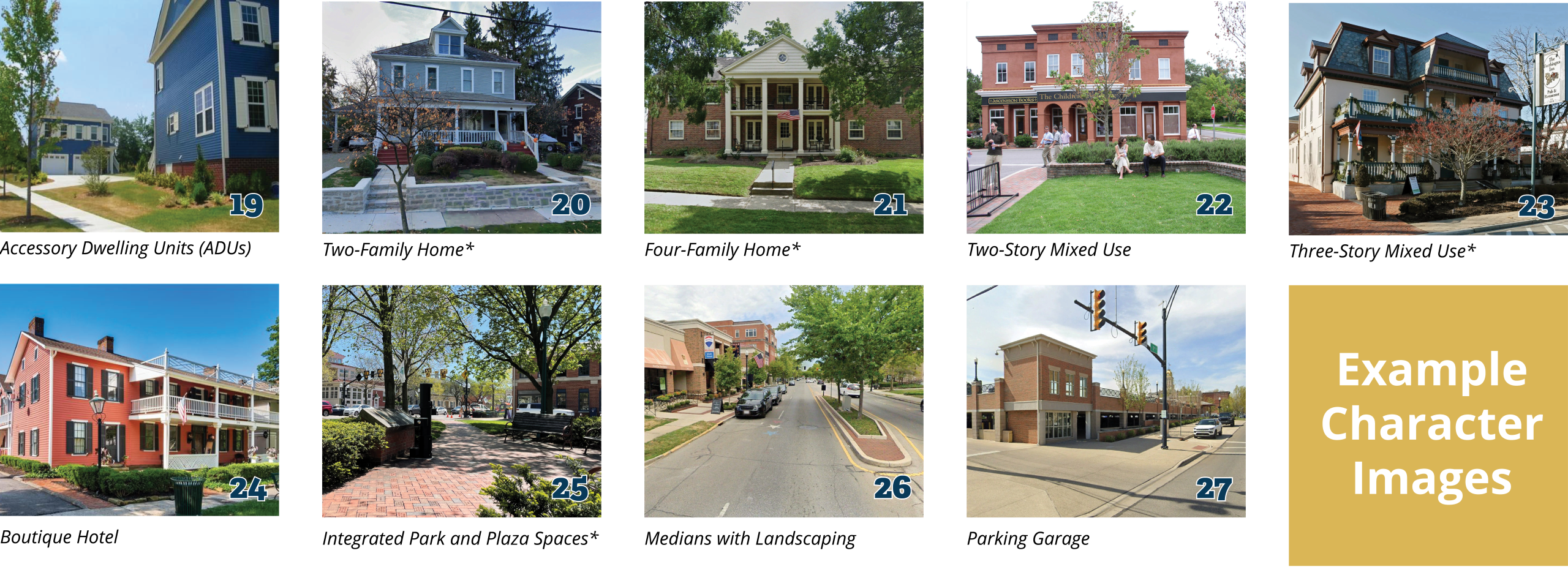
Average rating: 4.04

1. Create a vibrant gateway into Worthington at or near the intersection of High Street and Selby Boulevard with distinct building and public realm design elements that welcome people into the community.
2. Support gradual redevelopment to maximize underutilized space, bringing buildings closer to the street with parking behind to create a more active ground floor.
3. Transition building scale and heights along High Street between the historic character of Old Worthington to the north and the Zone-In efforts completed by Columbus to the south, where four-story buildings are permitted.
4. Create a stronger pedestrian and bike connection to Old Worthington with wider sidewalks, improved landscaping, and street furniture such as benches and covered bus stops.
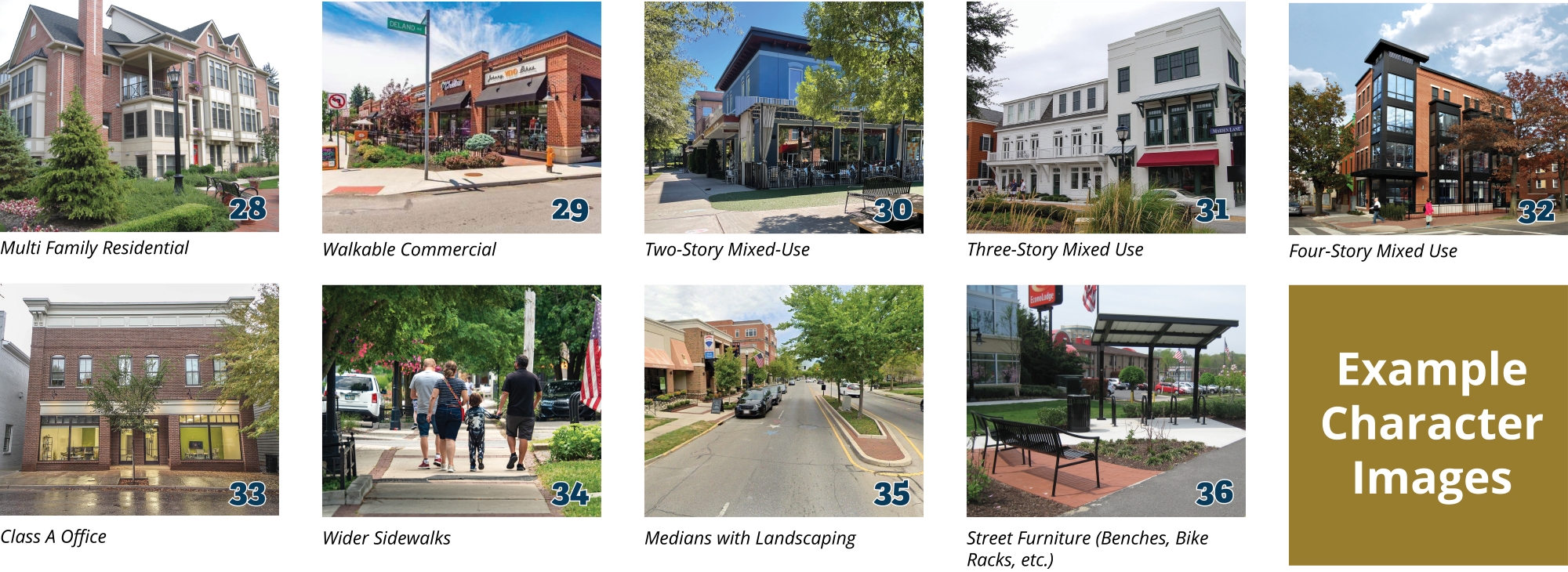
Average rating: 4.2
Central Focus Area
Total entries: 288
What should the future of the Central Focus Area look like? Review the three land use and character concepts below that were drafted by the Community Committee based on what they’ve learned in the planning process so far. These concepts are not specific proposals, but are intended to get community feedback on what elements of the area’s future are most supported.
Purpose: Gain a better understanding of what you support and what you don’t support…and why.
For each concept, participants rated how strongly they support this direction, where 1 represents low support and 5 represents strong support, and answered the following questions to explain their rating.
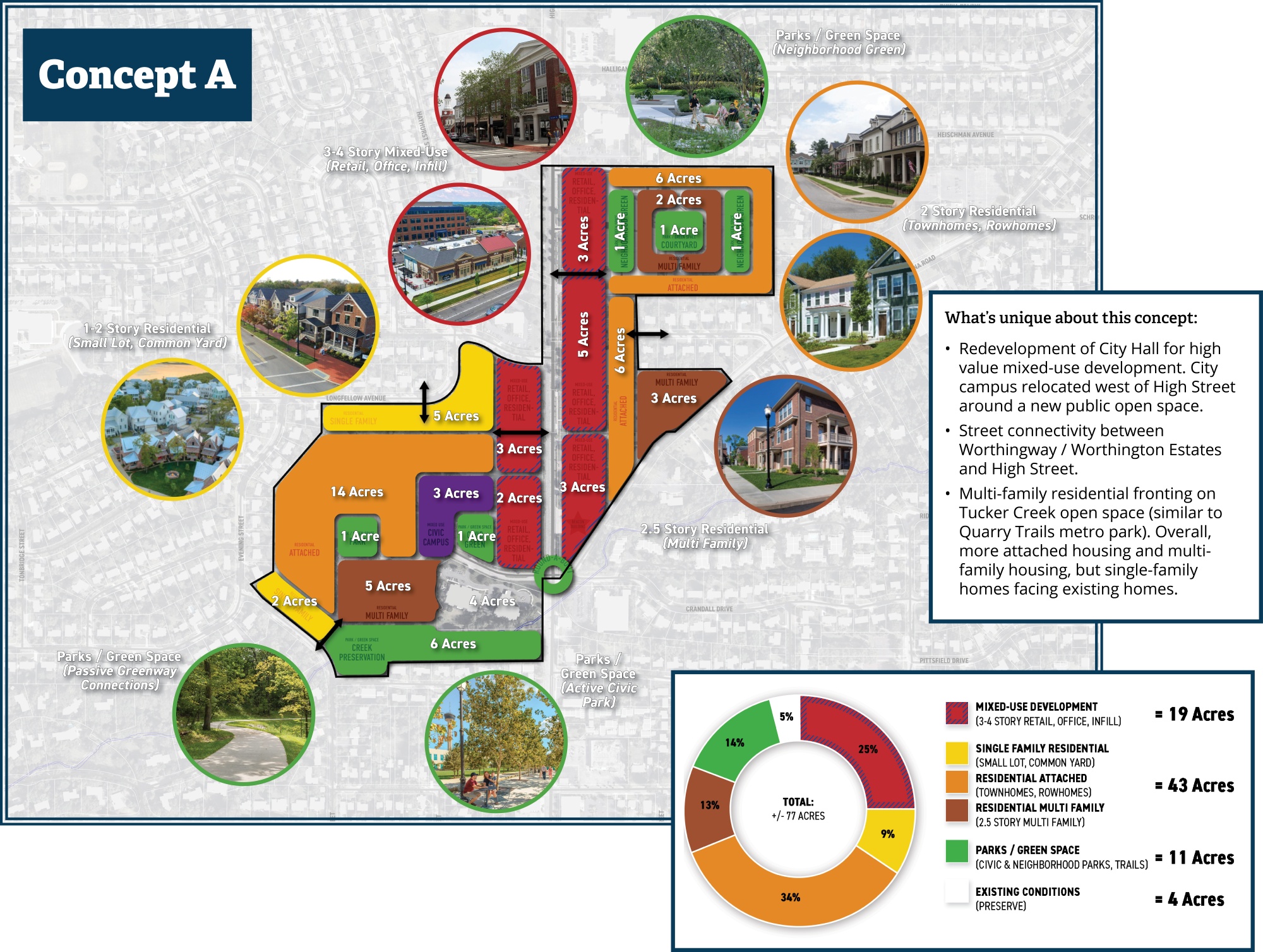
Average rating: 2.45
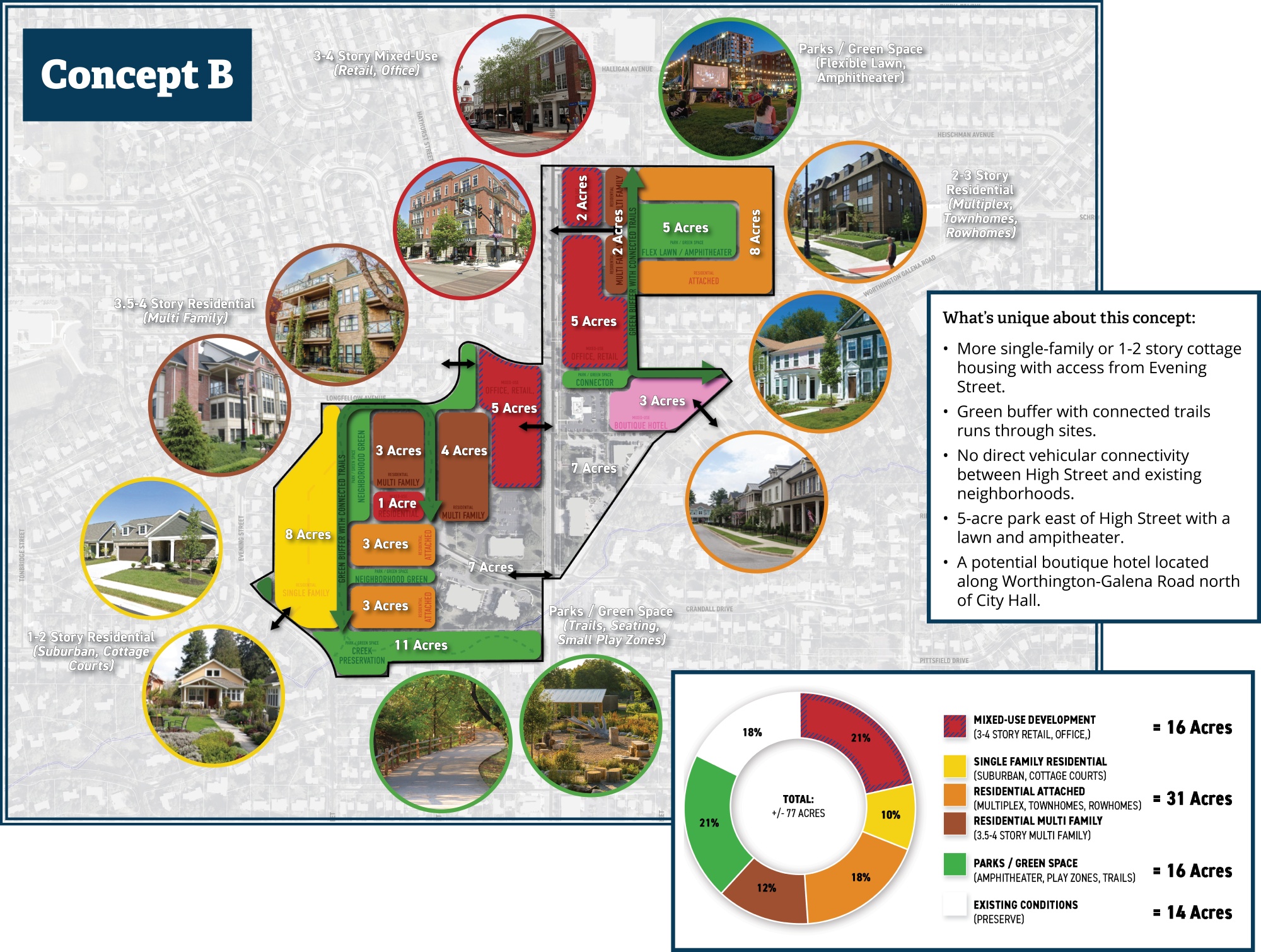
Average rating: 2.8
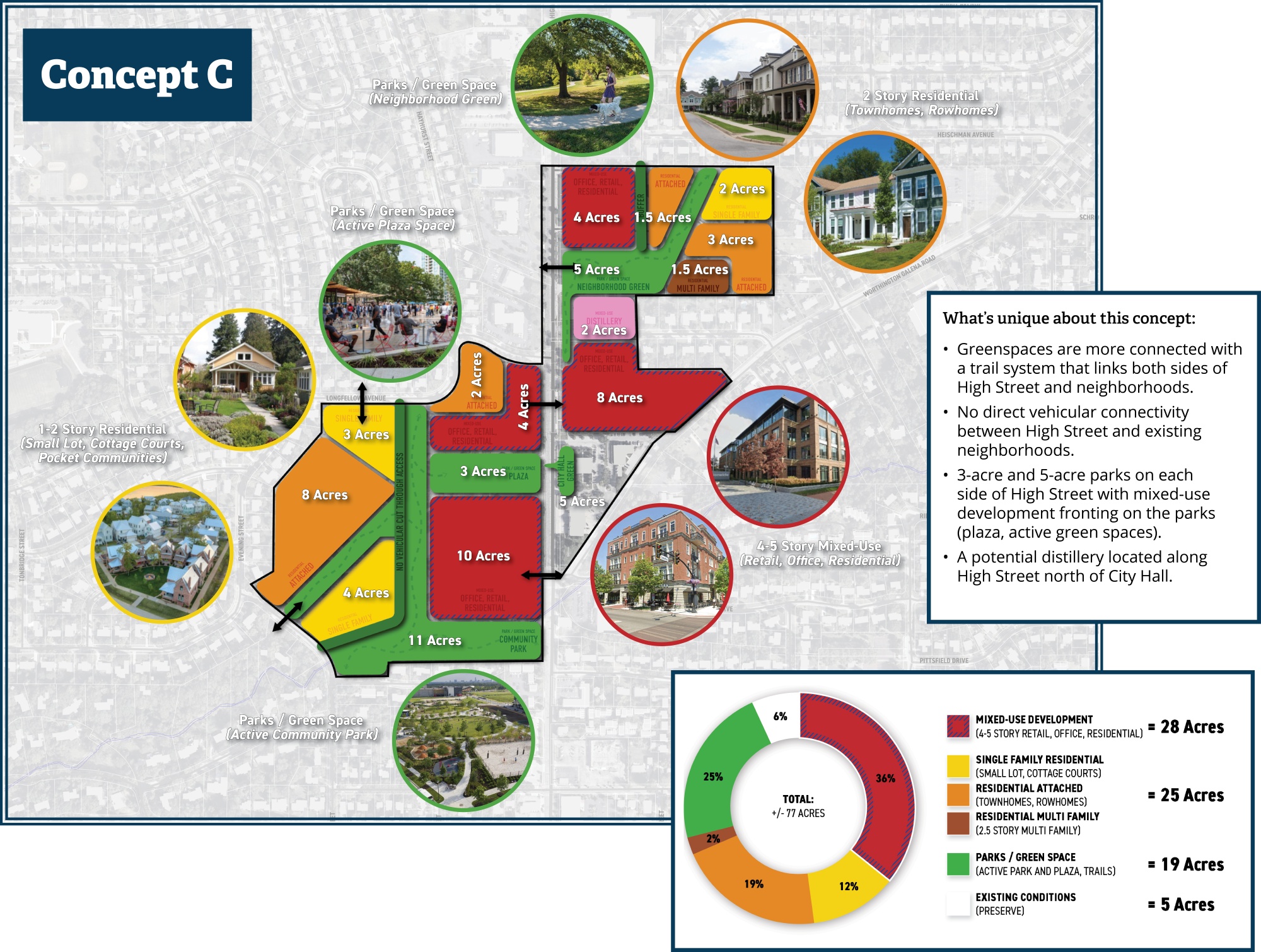
Average rating: 3.04
Key Questions
Participants answered the following questions to let us know what considerations are most important to them in the future development of the Central Focus Area.
1. How important is it that each of the following land uses are included in this area?
Residential (various types)
Average rating: 3.55
Parks, open space, public spaces
Average rating: 4.32
Commercial and Office Uses
Average rating: 3.18
Mixed Use (Commercial, Office, and Residential)
Average rating: 3.4
2. How important are each of the following characteristics of future development of this area?
Architectural design or quality of building materials
Average rating: 4.34
Public gathering spaces or active recreational amenities
Average rating: 4.38
Centralized and shared parking
Average rating: 3.57
Fiscally positive for the city
Average rating: 4.04
Appropriate transitions in building scale or use to existing neighborhoods
Average rating: 4.18
Limiting vehicular connectivity to existing neighborhoods
Average rating: 3.67
3. How strongly would you support the following types of residential in this area?
Single-family homes
Average rating: 3.75
Senior-friendly housing (smaller, single-story homes)
Average rating: 4.1
Attached housing (townhomes, duplexes, fourplexes)
Average rating: 3.41
Multi-family housing (owner-occupied, like condos)
Average rating: 3.38
Multi-family housing (rental)
Average rating: 2.6
4. How strongly would you support the following building heights along High Street in this area?
1-3 stories
Average rating: 4.07
4-5 stories
Average rating: 2.66
5. How strongly would you support the following types of connectivity between the future development of this area and nearby neighborhoods?
No new vehicular connectivity to existing neighborhoods (only pedestrian and cyclist)
Average rating: 3.53
Street connectivity to serve new residential areas only
Average rating: 3.05
Street connectivity between High Street and existing neighborhoods
Average rating: 2.6
6. Did we miss anything? What is most important to you about the future of this area?
Count: 74
About You
Total entries: 294
This section displays the results of the “About You” questionnaire. This questionnaire is used to understand the demographic background of participants and to tailor future outreach and engagement activities. Not all participants submitted the questionnaire or answered every question.